
Installation
What happens during a heat pump survey — and what should I ask?
Published · Written by Towsty Editorial Team
If you’ve booked a heat pump survey, you might be picturing someone glancing at your boiler, jotting down a number and heading off. A good survey is nothing like that, and knowing what should happen is one of the easiest ways to spot a great installer from an average one.
Here’s what to expect, and the questions worth asking while they’re there.
Why is there a survey at all?
A gas boiler is a bit like a kettle - it blasts out heat on demand, so it doesn’t matter much what house it’s in. A heat pump is different. It works gently and steadily, so it must match your home the way a suit is fitted to a person. Get the sizing right and it’s brilliant. Guess at it, and it can struggle.
The survey is where that matching happens. It’s not a sales visit; it’s the design work your whole system depends on.
If you are still deciding whether the technology fits your property, start with our guide to heat pump suitability.
What a good surveyor does
- Measures up your home. Expect them to go room to room with a tape measure or laser measure - windows, walls, floors, ceiling heights. They’ll want to know what your walls are made of, what insulation you’ve got in the loft, and roughly when the house was built. Construction and upgrades affect heat loss, so the surveyor needs to understand your home rather than rely on its age alone.
- Works out heat loss, room by room. This is the heart of it. They’re calculating how quickly each room leaks warmth on a properly cold day, so the heat pump can be sized to keep every room comfortable; not just the house “on average”. If someone quotes you a system size without doing this, that’s a guess, not a design.
- Checks your radiators. Heat pumps run at a lower temperature than boilers, so radiators need enough surface area to share that gentler heat around. The surveyor should note the size and type of every radiator and tell you if any need swapping for larger ones.
- Looks at your hot water. Most heat pumps heat your water using a cylinder: a tank that stores hot water ready for taps and showers. If you don’t have one, the surveyor will look for somewhere sensible to put it, like an airing cupboard or under the stairs.
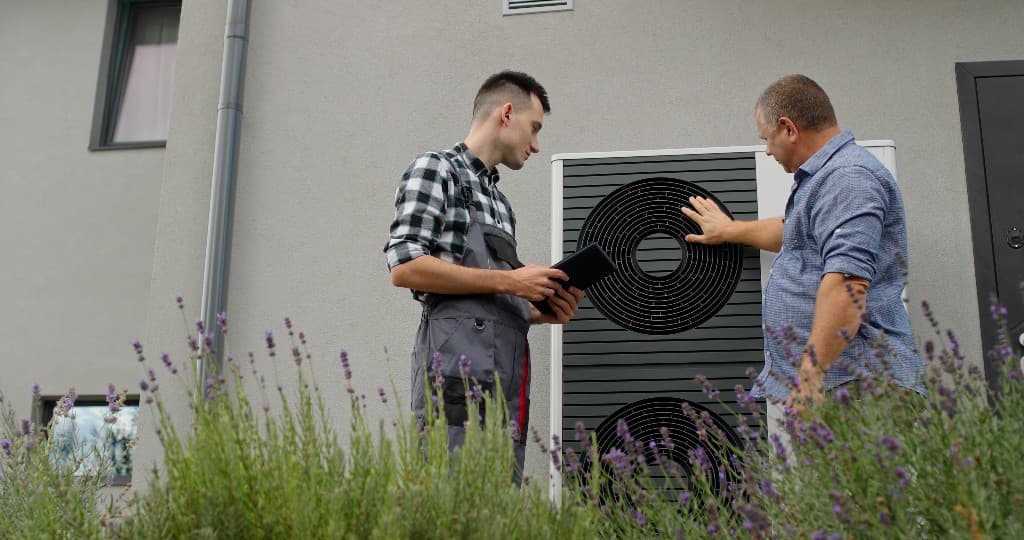
- Finds a home for the outdoor unit. They’ll suggest a spot outside with good airflow, and they should carry out a noise check: a simple calculation that makes sure the unit will be quiet enough for you and your neighbours. It’s a standard rule all MCS-certified installers follow, so it’s worth hearing them mention it unprompted.
You can verify an installer through the official MCS installer search.
How long should it take?
A proper survey usually takes one to two hours, depending on the size of your home. If someone is in and out in twenty minutes, or offers to quote from photos alone, be cautious. A price without a real survey behind it has a habit of changing later, or worse, the system gets installed and never quite performs.
Questions to ask during a heat pump survey
You don’t need to be technical. These few questions tell you a lot about who you’re dealing with:
- “Will I get a copy of the heat loss calculation?” A confident installer will say yes without hesitating.
- “Which radiators will need changing, and why?” The answer should be specific, not vague.
- “Where will the outdoor unit and cylinder go?” They should show you, not just tell you.
- “What temperature will each room reach on the coldest days?” A good design has an answer for every room, including that chilly one.
- “What will it roughly cost to run?” An honest surveyor gives a realistic range, not a miracle number.
The bottom line
A heat pump survey isn’t a formality - it’s where a good installation is won or lost. A surveyor who measures everything, explains what they’re doing and happily shares their workings is exactly who you want fitting your system. And now you know what to look for, you’ll spot them straight away.
Once the design is clear, your installer can confirm grant eligibility. Read how the Boiler Upgrade Scheme works, or see what a well-designed system feels like in our guide to heat pump comfort.